Prisoners Out of Sight, Out of Mind for Public

face of a prisoner

In 2003, a U.S. Supreme Court justice, addressing a large and important meeting of lawyers, declared:

When the prisoner is taken away, our attention turns to the next case. When the door is locked against the prisoner, we do not think about what is behind it. … As a profession, as a people, we should know what happens after the prisoner is taken away. … Out of sight, out of mind is an unacceptable excuse for a prison system that incarcerates over two million human beings in the United States.^

In 1869, a book containing a woman’s first-person account of her experience as a matron of a woman’s prison was published in New York. That book ended with an urgent appeal:

Every one who has the cause of humanity at heart will echo the cry, open the doors of our prisons, as the doors of other public institutions are thrown open, so that those who support them may have an opportunity to inspect them.

It is the right of every tax-payer to know what is done within our prison walls at all times. It is the duty of every Christian man to make himself acquainted with the moral bearing of the discipline which obtains within them.

It is the duty of every religious woman to see that her fellow woman is not trampled down in degradation and vice, lower than her own sins would carry her, by the heel of her master in discipline.

Let the prison doors be opened, and the inside of them exposed to the view of all. Knowledge awakens interest, and interest leads to action.

If the people of this land could be roused to examine the subject, our prisons would soon be managed upon principles which would tend to the elevation of the wretched beings who now come out of them more degraded and hardened in the commission of crime than they go in.^

Prominent civic organizations inspected prisons and engaged in public discussion of prison policies in nineteenth-century America. The Prison Association of New York was a leading example of such a civic association. These organizations functioned according to a public knowledge / public action model of progressive political change.

The public knowledge / public action model of progressive political change has significant, systemic weaknesses. Particularly in the Internet era of rapidly expanding communication possibilities, gathering and maintaining public attention at a national political scale is difficult. That’s true even in relation to the fundamental government function of criminal punishment. Moreover, the imperatives of seeking public attention create biases in communication. In nineteenth-century public deliberation, international experts on prison policies formed a consensus that prisoners’ communication should be suppressed. By the late twentieth century, the public knowledge / public action model spurred an extraordinary rise in incarceration based significantly on grotesquely false public information.

Democratic change doesn’t depend only on the public knowledge / public action model. Personal experience and personal communication isn’t equivalent to acquiring public knowledge. Persons can act publicly out of convictions and understandings that they cannot explain through public reason. Effective democracy depends not just on public discussion, but also on personal communication and personal experience. Improving communication between prisoners and their families and friends can help to counterbalance weaknesses of public knowledge and mass communication.

Sentences to Imprisonment Ignore Communication

face of a prisoner

In the U.S., a statutorily driven shift over the past twenty-five years to much less judicial discretion in sentencing has emphasized punishment being represented as months of imprisonment. Probation, parole, and other alternative sanctions imply different communication capabilities for persons being punished. Developments in communication technologies have greatly expanded possibilities for communicating with prisoners. Nonetheless, across the world, prisoners’ communication opportunities have had little importance in thinking about sentencing and punishment.

Equal sentences to months of imprisonment can lead to large inequalities in punishment. Imagine José, an illiterate immigrant not speaking the dominant local language, married, with five children and with a low-paying job as a dishwasher in a bustling city restaurant. He is imprisoned in a rural area more than 250 miles away from where he had previously lived. By the decision of the prison administrator of the prison to which José happened to be assigned, prisoners are permitted to receive visits only from immediate family, from 8am to 5pm on Saturday and Sunday, and for no more than one hour once per week. Visits are non-contact visits in which a glass partition separates prisoners from visitors.

Imprisonment is harsh, isolating punishment for José. Because visiting José is expensive and burdensome, his family and friends rarely visit him. Those rare visits have a much different communicative structure than the casual in-person communication with family and friends that was a major aspect of José’s life. Moreover, permitted communication excludes friends and extended family that were also a central part of José’s social world. Because José cannot read or write, he lacks the ability to communicate through letters. The relatively high price of inmate telephone service, along with his family’s low income, makes communication by telephone a major budgetary concern. Months of imprisonment for José mean months of exile from his normal world.

Contrast José’s prison sentence with another sentence to the same number of months of imprisonment. Imagine Daniel, who is single, with no children and with a job as a computer programmer. Daniel’s brother and father, who are the only relatives with whom Daniel has an ongoing relationship, live only a short drive from where Daniel is imprisoned. By the decision of the prison administrator of the prison to which Daniel happened to be assigned, prisoners are permitted daily visits, without specific time or frequency limits. No barriers are placed between prisoners and visitors. Prisoners and visitors are allowed to make ordinary bodily contact such as hugging. Any person not specifically found to present a security risk is allowed to visit a prisoner. Moreover, Daniel’s brother and father, as well as work colleagues seeking technical consultation, could each readily spend $100 per month on telephone calls with Daniel.

Imprisonment could have little effect on Daniel’s typical pattern of activity and social interaction. Daniel is an avid science-fiction reader, virtual-world participant, blogger, and email correspondent. Before he was imprisoned, he spent much of his work and leisure time alone in front of a computer. If a computer with a reasonably good Internet connection were installed in a corner of his prison cell, Daniel’s loss of physical freedom in prison would change little the liberty he exercised in the preponderance of his time before he was imprisoned. The cost to Daniel for communicating with his father and brother from prison isn’t economically significant for them. Since outside prison they typically communicated rarely, the actual cost of maintaining their normal level of communication with Daniel in prison is low.

Widely debated purposes of punishment have no clear relation to the communicative dimension of punishment. Incapacitating criminals, such as a murderer considered to present a risk of further physical violence, often does not require tight restrictions on non-physical communication with family, friends, and other persons. Retribution doesn’t imply any particular combination of loss of property, physical suffering, loss of physical liberties, and loss of communication capabilities. Holding constant some composite measure of punishment severity, more communication with persons being punished might promote general deterrence by increasing recognition among other persons of the punishing consequences of doing wrong. On the other hand, if persons being punished were idealized as heroic rebels, communication might weaken general deterrence. With respect to rehabilitation, increased communication with the outside world aids prisoners’ re-entry into that world. It helps prisoners to escape from a cycle of recidivism. Many prisoners, however, have difficult, painful personal and familial relations. Rehabilitation is easier to embrace as an ideal when communication restrictions give persons an opportunity to disengage from difficult relationships and shift responsibility to a separate class of rehabilitation professionals. Rehabilitation professionals have professional incentives to support rehabilitation. Depending on circumstances, communication with such professionals might be more or less effective than communication with family and friends in promoting released prisoners’ integration into law-abiding life.

In high-income democracies, most persons are much more concerned about public safety than fair and just punishment of persons convicted of crimes. Persons who have extensively studied the U.S. criminal justice system have concluded that it’s failing badly to provide fair and just punishment for reasonably defined crimes. The public largely doesn’t care about that failure. Crime and public safety are much more prominent public concerns. With new communication technologies, reasonably ensuring public safety is consistent with a wide range of possibilities for communicating with prisoners.

Personal Communication with Prisoners is Publicly Significant

face of a prisoner

Public policy toward communication with prisoners would benefit from more appreciation for ordinary practices of communication. A recent philosophical analysis of criminal punishment argued:

criminal punishment should be conceived of as a communicative enterprise that aims to communicate to offenders the censure they deserve for their crimes, and thus to bring them to repent their crimes, to reform themselves, and to reconcile themselves with those they have wronged.^

Such communication primarily concerns authoritative communication with the person being punished. Authoritative communication with prisoners conveys to them social rules that they must obey. Authorities’ communication with prisoners might also help to generate knowledge useful for authorities designing rehabilitation programs. Such communication clearly serves, at least formally, the public interest.

Much communication is neither authoritative nor instrumental. Personal communication with family and friends has largely driven the development of the communications industry over the past century. Personal communication emphasizes mutual subjectivity rather than distinctive authority. Personal communication is a natural human activity, not an instrument designed to serve public purposes. Most communication with prisoners, like most communication with other persons, is non-authoritative, non-instrumental communication with family and friends.

Prisoners’ communication with family and friends has important systemic consequences. Understandings created through such communication connect to wider networks of shared representations:

Systemic deficiencies are experienced in the context of individual life histories; such burdens accumulate in the lifeworld. …Besides religion, art, and literature, only the spheres of “private” life have an existential language at their disposal, in which such socially generated problems can be assessed in terms of one’s own life history. Problems voiced in the public sphere first become visible when they are mirrored in personal life experiences.^

Public action to address systematic problems in imprisonment might develop from public representations mirrored in personal life, or from the prevalence of similar private, existential encounters. Other possibilities for personalization and democratic significance exist outside the conceptual categories public and private. Even apart from anyone’s ability to provide good reasons for an action, interpersonal communication has great significance for public action.

Prisoners’ communication with family and friends mitigates structural weaknesses in public communication. Prisoners are related to other community members. Prisoners are highly disproportionately men. Prisoners suffer from imprisonment. These are easily accessible, incontestable truths. However, deliberative democracy and vigorous competition in symbolic markets systematically suppress effective expression of these truths. In prisoners’ communication with family and friends, personal relations, male identity, and suffering figure centrally and evoke responses.

Providing prisoners with adequate communication services at reasonable charges is in the interests of everyone participating in democratic self-governance. Greater prisoner communication with family and friends improves prisoners’ prospects for re-entering successfully the outside world as tax-paying, law-abiding persons. Expanding secure, monitored communication opportunities for prisoners increases data for forensic analysis and legitimate law-enforcement actions. Expanding such communication opportunities also fosters development of the inmate communication service industry. Most importantly, prisoners’ communication with their families and friends are crucial to the democratic governance of punishment. Reforming and expanding communication with prisoners should be an important aspect of the ongoing, profound communications revolution.

Public Discourse Concerning Prisoners’ Communication

face of a prisoner

Public discourse has not fully valued prisoners’ communication with their families and friends in the free world. In the nineteenth century, imprisonment became the predominate form of punishment in industrializing countries. Philosophers, philanthropists, politicians, religious and civic leaders, and government bureaucrats sought public knowledge about prison conditions and vigorously discussed the effects of prison design and administration. They determined isolation, solitude, and silence to be the best treatment for prisoners.

Early nineteenth-century public deliberation about penal policy focused on the value, cost, and means of eliminating prisoners’ communication with other prisoners. Prisoners’ communication with family and friends was scarcely a topic of discussion. Compared to communication among prisoners, prisoners’ communication with family and friends relates more tangentially to the design of state institutions. It highlights differences between the ideals of public deliberation and the class basis of its practice. Prisoners’ communication for family and friends offers an unpropitious subject for claims of technical expertise and for the promotion of knowledge. These aspects of communicative structure fostered public deliberation forming an implicit consensus to suppress prisoners’ communication with family and friends.

Legitimate penological interests have enlarged prisoners’ opportunities to communicate with other prisoners and with family and friends. From the mid-nineteenth century to the present, prisoner population growth, fiscal constraints, and pragmatic administrative practice expanded prisoners’ opportunities to communicate with other prisoners. During that time, prison officials, acting in accordance with their individual legitimate authority, produced a general, uncoordinated, publicly invisible liberalization of prisoners’ communication with family and friends.

The public value of prisoners’ communications now tends to be discussed quite narrowly. Problems of prison overcrowding and prison rape are now typically considered without considering whether more or less communication among prisoners is generally desirable. Prisoners’ communication with family and friends is now typically discussed in terms of constitutional rights of prisoners, rational prison management, and prisoner re-entry into free society. The more general public interest in prisoners’ communication with family and friends remains largely unexpressed in public discourse.

Visiting Peregrinus Proteus in Jail

face of a prisoner

About 1850 years ago, Peregrinus Proteus, a philosopher and publicity-seeker, was thrown into jail. This event “set him up for his future career: now he had standing, a magic aura, and the public notice he was so passionately in love with.” Followers and friends, some traveling from far way, visited him in jail and offered him advice and consolation. They brought him full-course dinners, spent nights in jail with him, and “money poured in from them; he picked up a very nice income this way.” Apparently concerned that punishment only served Peregrinus’ interests, a government official with appreciation for philosophy put an end to his imprisonment:

Peregrinus was released from jail by the governor of Syria. The governor had a penchant for philosophy and, fully aware that Peregrinus was enough of a lunatic to welcome death that would give him a martyr’s acclaim, set him free without considering him worth even the customary flogging.^

Proteus then found other forms to attract attention: shocking use of his own body, insulting the emperor, and giving elaborate speeches. Finally, after extensive, ostentatious preparations, Peregrinus Proteus immolated himself just outside the great sanctuary of Zeus at Olympia, shortly after the Olympic games. His death brought him the enduring notoriety that liberation from imprisonment had denied him.

Historical Communication with Prisoners

face of a prisoner

Having considerable freedom to communicate with prisoners was not unusual prior to the nineteenth century. By the early fourteenth century, prisons existed within the central space of European city-states such as Bologna, Florence, Siena, and Venice. These medieval prisons allowed considerable personal interaction between prisoners and the outside world:

Prisoners … were visible: they roamed the city as licensed beggars, as debtors in search of settlement, and as criminals en route to court. And inmates’ visibility increased during civic events such as routine festive releases, triumphal amnesties, and occasional riotous break-ins accompanying political turmoil. At the same time, there were many incomers to the prison: servicemen, lawyers, and physicians; guards and prison administrators; local priests, lay and religious friars, confraternity members, and court magistrates; families traveling far and near to supply their imprisoned kin with food and cash; prostitutes on nocturnal calls; and of course the daily flow of new and recidivist offenders.^

The prisons in Florence and Venice lacked a prison kitchen. Prisoners depended on outsiders regularly bringing them food.^

Consider the treatment of an imprisoned murderer. About 1604, Elizabeth Caldwell was convicted of murder and sentenced to death. While awaiting her execution, she was held in a gaol in Chester, England. She was not regarded as a monster to be shunned and destroyed. She received up to three hundred visitors a day while imprisoned.^

Debtors’ prisons in mid-eighteenth-century England were crowded with debtors’ wives and children. The debtors’ wives and children could enter and leave the prison at will. Many chose to live within the prison with their debtor husband or father. Wives and children of men imprisoned for debt made up two-thirds of the population of two major debtor’s prisons in London about 1776.

Prisons holding felons also freely admitted visitors. A visiting clergyman at Newgate Prison in London noted that a pregnant wife visited her husband daily “to supply him with sufficient food and when they were together they rarely talked, but she simply sat at his side; throwing her arms around his neck.”^ Prisoners also had ready access to visits from prostitutes. In 1702, London officials were informed that the deputy-keeper of Newgate permitted “lewd women and common strumpets…to constantly lay there all night.”^

About 1700 in the Massachusetts Bay colony, a young woman sentenced to be hung spent more than eight months imprisoned. She was imprisoned in a town in which she had not been previously known. Nonetheless, she received frequent visits from townspersons. She also was invited to leave the prison to attend “private Meetings of Christians in the Town.”^ Ordinary persons throughout colonial America freely communicated with prisoners. They threatened lawsuits if access to prisoners was denied.^

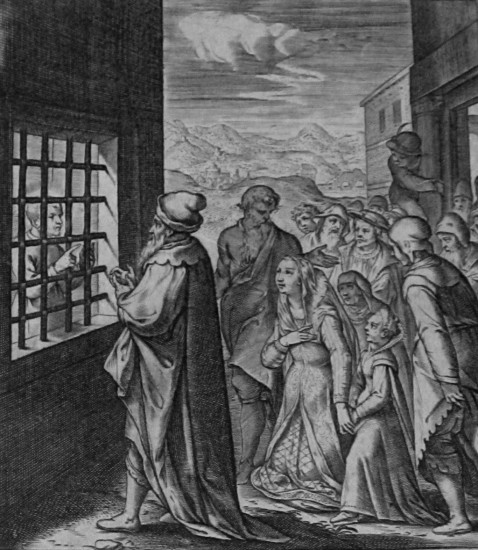
Ignatius Loyola in Prison
From the 1609 Illustrated Biography of Ignatius of Loyola, plate 36

Imprisonment prior to the nineteenth century implied a change in residence and in legal status. Imprisonment prior to the nineteenth century did not imply deprivation of the liberty to communicate with family and friends.

Prisons’ Means for Suppressing Prisoners’ Communication

face of a prisoner

The United States early in the nineteenth century provided operational models of tightly suppressing prisoners’ communication with other prisoners and with non-prisoners. Communicative isolation of prisoners occurred in Philadelphia on a small scale late in the eighteenth century. In the early nineteenth-century, the Auburn State Prison in New York and the Eastern State Penitentiary near Philadelphia developed explicit, generally applied regimes for suppressing prisoners’ communications. These regimes were recognized as leading examples for penal practice and were adopted world-wide. The U.S. historically led the world in the development of a free press and an extensive postal system to support free circulation of ideas. The U.S. also led the world in suppressing prisoners’ communication.

The Auburn regime of suppressing prisoners’ communication developed through widely different practices. Prior to 1817, the Auburn State Prison allowed extensive communication among prisoners. From 1817 to 1823, Auburn shifted to solitary confinement for every prisoner and then to allowing prisoners to eat, exercise, work, and worship in each others’ presence, but under a rule of strict silence.^ The latter regime became known as the Auburn System, the Congregate System, or the Silent System.

While allowing congregate activities during the day, Auburn Prison nonetheless strictly suppressed communication among prisoners. Groups of prisoners moved from place to place in “lock-step,” a rigidly spaced single-file line of persons with their heads turned to the right. This formation gave guards a clear view of the prisoner lips and helped them to detect any attempts to communicate. In the dining hall, convicts sat on only one side of narrow tables, “face to back,” “so as to avoid exchanging looks or signs.” Prisoners worked in a common room in strictly supervised silence. While prisoners could see each other’s bodies, a “highly important regulation” instructed officers:

prevent any convict from ever speaking to another convict, without special direction from and under the eye of a Keeper, under all circumstances where such a rule could possibly be enforced.^

One visitor to Auburn noted there during the day “profound silence,” and in the evening, “the silence within these vast walls, which contain so many prisoners, is that of death.”^ Another visitor stated that while the prisoners worked together, “Not even a whisper is heard; though the silence is such that a whisper might be heard throughout the whole apartment.”^

prisoner's cell at Eastern State Penitentiary
Prisoner’s cell at the (no longer operational) Eastern State Penitentiary

Eastern State Penitentiary was specifically designed to suppress prisoners’ communication. Eastern State received its first prisoners in late October, 1829. The penitentiary suppressed communication among prisoners by isolating prisoners in separate cells day and night. Each prisoner had a cell that included a flush toilet, a small portal through which food could be delivered without the guard being seen, and a skylight. Attached to each cell was a small, individually walled exercise yard that the prisoner could use one hour per day. Prisoners ate, worked, and listened to religious instruction from their individual cells.^ Prisoners were forbidden to attempt to communicate with those in adjacent cells, and they were ordered to “not make any unnecessary noise, either by singing, whistling, or in any other manner; but in all respects preserve becoming silence.”^ Hoods were placed over the prisoners’ heads when they were moved within the prison, so that they would not inadvertently catch sight of another prisoner.^ As an ideal, Eastern State Penitentiary eliminated prisoners’ sense of each other’s presence in prison. It sought to suppress any means for prisoners to recognize each other after they left prison. Eastern State Penitentiary became the leading representative of what was called the Pennsylvania System or the Separate System.

Official Communication with Prisoners at Auburn and Eastern State

face of a prisoner

While in the nineteenth century Auburn State Prison and Eastern State Penitentiary strictly suppressed communication among prisoners, both provided for official communication with prisoners. The prison warden and prison physician could communicate with prisoners, perhaps visiting each prisoner once every two weeks. Legislatively appointed prison inspectors visited each prisoner about once per month in the course of reviewing prison conditions and monitoring the treatment of prisoners.

Religious officials also interacted with prisoners. Auburn State Prison paid a full-time chaplain to provide services in the Chapel, teach Sunday school, and visit prisoners in their cells. The Pennsylvania legislature, in contrast, initially stipulated that a religious instructor serving Eastern State Penitentiary had to provide service gratuitously. The reluctance of the legislature to fund a chaplain seems to have been related to sectarian conflict.^ From 1829 to 1838, Eastern State thus had no religious instructor. A subsequently funded Moral Instructor visited each Eastern State prisoner roughly monthly.

Members of civic organizations assumed responsibilities for visiting prisoners. In Pennsylvania, a well-established philanthropic organization, the Philadelphia Society for Alleviating the Miseries of Public Prisons, was authorized to have its members visit prisoners. Philadelphia Society members visited Eastern State Penitentiary weekly from the beginning of Eastern State’s operation.^ In New York State, the Prison Association of New York provided a similar, but less formal and less active, visiting service.

The small number of persons authorized to communicate with prisoners and the large number of prisoners meant that prisoners in Auburn State Prison and Eastern State Penitentiary about 1850 spent on average little time communicating with physically present human beings. Even after Eastern State had hired a full-time moral and religious instructor, prisoners there probably spent on average less than fifteen minutes per day in the physical presence of another person.^ In Auburn, prisoners’ authorized opportunities to speak probably averaged less than fifteen minutes per day.

Suppressing Prisoners’ Communication with Family and Friends

face of a prisoner

Both Auburn State Prison and Eastern State Penitentiary, celebrated nineteenth-century pioneers in penal policy, vigorously suppressed prisoners’ communication with family and friends. About 1822, Auburn State Prison established the regulation:

That the convicts shall receive no letters or intelligence from or concerning their friends, or any information on any subject out of the Prison; nor be permitted to write letters themselves: That no relation or friend shall be allowed to speak to a convict, except in some extraordinary case, where the condition of his property or family imperiously requires it, and then only in the presence of the Agent or Deputy Keeper: but that any information concerning the convicts will be furnished to their friends on personal application, or by letter, post-paid, directed to the Agent.^

Reporting on interviews with prisoners being prepared for discharge in 1825 and 1826, Auburn’s keeper noted that the prisoners uniformly agreed that “being deprived of all intelligence of their friends and the affairs of the world” caused great suffering. Prisoners felt that they had brought “disgrace, suffering, and ruin…upon those to whom they are allied by kindred and affection, and of whose condition and fate their ignorance keeps them in a constant agony of suspense.”^ For typical terms of imprisonment of two to three years, and sometimes much longer, a prisoner was thus “literally buried from the world,” to be restored to society “as ignorant of its current events as if he had risen from the dead.”^ ^

Eastern State Penitentiary, like Auburn State Prison, suppressed prisoners’ communication with family and friends. Officials responsible for prison reform in Pennsylvania visited Auburn in 1826. After returning, they requested a written response to eighteen detailed questions. These questions included:

10’th. Are the visits of friends of convicts, and others, permitted in your prison; and under what rules and restrictions? What is your opinion as to the policy of suffering any such interference with prisoners?^

Note the tendentious phrase “suffering any such interference.” Eastern State officials already knew that Auburn State Prison suppressed prisoners’ communication with the outside world. The written questions apparently were the time-honored bureaucratic tactic of seeking predictable documentary support for a preferred policy direction.

When Eastern State began operating in 1829, it allowed no communication between prisoners and the outside world. According to Eastern State’s warden, prisoners “were deprived from all intercourse or knowledge of every kind with either their family or friends.”^ A Pennsylvania law enacted earlier that year formally declared this communicative regime of imprisonment:

None but the official visitors can have any communication with the convicts, nor shall any visitor whatever be permitted to deliver to or receive from any of the convicts, any letter or message whatever, or to supply them with any article of any kind under the penalty of one hundred dollars fine^

Eastern State prisoners suffered greatly from suppression of their communication with their families. Official French visitors to Eastern State in 1831 published notes from their interviews with prisoners. They included these descriptions:

No. 28 – he finds a kind of pleasure in solitude, and is only tormented by the desire of seeing once more his family…

No. 41– sheds tears during our whole conversation, particularly when he is reminded of his family.

No. 85 – If you speak of his wife and child, he weeps bitterly.

No. 00 — He cannot think of his relations without melting into tears; he takes from under his bed some letters which his family has succeeded in sending to him. These letters are almost in pieces, in consequence of being read so often; he reads them still, comments upon them, and is touched by the least expression of interest which they contain.^

The last account indicates that prisoners were occasionally allowed to exchange letters with relatives.^ Nonetheless, such communication evidently was strictly restricted. In 1847, Eastern State’s physician declared:

It might be well under suitable limitations to keep the prisoner informed of his family affairs, and the kind disposition of his friends towards him. At all periods of their sentences I have known husbands and fathers to suffer great anxiety to be informed of the health and circumstances of their wives and children ; and sons and daughters to know whether they will be again received into the domestic circle — on which, in an unguarded moment, they brought sorrow and disgrace — or be for ever denied the protection of a father’s roof.

As the separate system only professes to deprive the prisoner of intercourse with the vicious and abandoned, we may suppose that regular visits from a virtuous and honest relative could be permitted with safety, — nay, with advantage. Of course I would not recommend indiscriminate intercourse between the prisoner and his friends. Only such should be allowed to see him as are known to possess a character above reproach, and even they in the presence of an officer of the Institution.^

Again in 1850, Eastern State’s physician urged:

I believe that we should permit a much freer intercourse between the prisoner and his friends than is now the case. Letters – always passing through the Warden’s hands – and visits from such relatives as are known to pursue a virtuous life, might be made the means of infinite good to both the mind and morals of isolated convicts.^

The Philadelphia Society for alleviating the Miseries of Public Prisons was actively engaged in visiting prisoners. The Philadelphia Society and other important participants in public deliberation, however, discussed little prisoners’ communication with family and friends.

Prison administrators considered controlling prisoners’ communication with family and friends to be a powerful tool for controlling prisoners. In 1846, a penitentiary keeper argued that allowing prisoners to communicate with family and friends distracted them from prison labor. Other prison officials, to the contrary, viewed such communication as a key motivational tool. About 1860, an English social reformer asked an English prison administrator:

“Do you find,” we asked, “that you have the inmates of the jail under the same control now as in the days of thumb-screws, and gags, and brandings?”

“I think we have greater power over them, sir,” was the answer; “for at present, you see, we cut off the right of receiving and sending letters, as well as stop the visits of their friends; and a man feels those things much more than any torture that he could be put to.”^

Even though suppressing prisoners’ communication with family and friends was claimed to inflict pain more effectively than torture, suppressing prisoners’ communication with family and friends never attracted the public concern that penal torture did.

Arguing about the Effects of Silent vs. Separate Penal Regimes

face of a prisoner

Beginning in the late 1820s, fierce debates raged about the relative merits of the silent (Auburn) system and the separate (Pennsylvania) system of suppressing prisoners’ communication. Authorities directly associated with the founding and administration of the Auburn prison and of the Eastern State Penitentiary naturally tended to support their respective sides. Other prison discipline authorities readily chose sides and argued vociferously for one system or the other.^ For example, the Rev. Louis Dwight, a founder and long-time secretary of the Boston Prison Discipline Society, championed the silent system. In a report to the Boston Prison Discipline Society in 1846, Samuel Gridley Howe, a well-born Boston physician, abolitionist, and advocate of education for the blind, vigorously endorsed the separate system. He thus directly challenged Dwight and other Boston-based supporters of the silent system.^

Claims that the separate system produced death or insanity weren’t arguments for allowing ordinary communication among prisoners. Producing death or insanity were arguments for shifting to the silent system of suppressing prisoners’ communication. For example, prison officials in New Jersey and Rhode Island early in the 1840s argued that their prisons, operated under the separate system, were hurting prisoners and causing some to go insane. Rhode Island switched to the silent system about 1844, and New Jersey switched to the silent system between 1846 and 1849.^ In retrospect, this shift appears relatively insignificant and may have been motivated by prison over-crowding.

U.S. prisons operating under both the silent and separate systems of suppressing prisoners’ communication had prisoner death rates more than double that of the civilian population. In U.S state prisons from 1840 to 1843, the average (population weighted) death rate was about 2.7% of prisoners per year. In the U.S. in 1850, about 1.2% of males ages 20-49 (the most typical ages for prisoners) died per year. Differences in death rates between individual prisons, between black and white prisoners, and between male and female prisoners were much greater than death-rate differences between the silent and separate systems. Nonetheless, those differences attracted little public attention.

Deliberative competition between the silent and separate systems implicitly supported suppressing prisoners’ communication. In 1845, one participant in the public arguments observed:

What we desire to have borne in mind by the reader is, that the groundwork of amelioration has constantly been urged by all parties to be the prevention of communication amongst prisoners. Other things being equal, the extent to which this is secured in any penitentiary would be a fair test of the degree of perfection which that institution had attained^

About this time, Johann Ludwig Tellkampf, a German scholar and professor at Columbia University, read to the Prison Association of New York a scholarly analysis of the difference between the separate and silent systems.^ Proponents of the separate system sharply criticized his work:

He thinks a hundred persons, occupying the same apartment, but maintaining strict silence, are as truly separate, the one from the other, as if each individual occupied an entirely distinct and separate apartment. The Philadelphia system works “by means of bodily separation in partitioned cells,” and the “Auburn system” by enforcing silence during the day and separation during the night;” … so it seems that, by a ruse of the Professor, our system has lost its distinctive name and feature, and henceforth, the separate system which has always been silent, is to be identified with the silent system, which has never been separate! … the Auburn discipline cannot, by any possibility, prevent intelligible intercourse by signs. The plain truth on this point is, that the Pennsylvania system, be separating the convicts ENTIRELY, utterly precludes the opportunity of mutual corruption. The Auburn system, by silencing them when at work, and separating them at night, PARTIALLY prevents corruption in some of its worst forms, and certainly makes a great advance on the former condition of our prisons. …

If would be, indeed, an inexplicable phenomenon, if two systems of prison discipline, so diverse in principle and administration, as those adopted at Auburn and Philadelphia, should produce any thing like the same amount of reformation.^

With one sentence and a footnote, a proponent of the separate system condemned the widespread practice of exhibiting prisoners to the public for a spectator admission fee.^ Most persons arguing about the separate and silent systems did not mention prisoners’ communication with family and friends not imprisoned. Vociferous, decades-long public debates about how best to suppress communication among prisoners also largely excluded serious consideration of whether such suppression actually promoted reformation.

The extensive, antagonistic, and inconclusive deliberation about the Auburn and Pennsylvania systems eventually attracted other interests. In 1850, a knowledgeable member of the Prison Association of New York’s Prison Discipline Committee noted:

The experiments which the two prominent systems of Prison Discipline have been undergoing for the last twenty years, have not as yet resulted in any definite and very decided conclusions in favor of either. …the confidence of either party in the superiority of their system, seems not on the whole to be a whit abated. …In fact, the contest which has been so long waged between these opposing systems, seems to draw no nearer to a conclusion than it did some years since.^

Part of the deliberative problem was to disentangle effects of the different disciplinary regimes from other differences, such as different prisoner populations. The Prison Association member advocated further research to advance deliberation:

There seems, indeed, to be a fundamental difficulty in the way, which can only be satisfactorily removed by combining the two under one administration. Such a measure would afford us the opportunity of testing the comparative merits of each system under the same latitude, and as nearly as possible under the similar circumstances.^

The means for a such a test was constructing a new prison. The member stood ready with detailed plans: “working plans can be procured by those wishing to build, showing in detail the arrangement and construction of the building by addressing…”^ Supplying these “working plans” probably was related to personal, material interests.

Prison officials sought middle ground and additional facilities while making pragmatic decisions. In 1866, they generally favored supplementing the Auburn (congregate) system with solitary cells like those in the Pennsylvania (separate) system:

The theory of the congregate system of imprisonment is a rigid prohibition of inter-communication between the prisoners…. The opinion was very generally expressed to us by prison officials that it is, in all cases, desirable to supplement the congregate system with a number of solitary cells, sufficiently large, well-lighted, and well-aired to serve for workshops as well as sleeping rooms.^

By 1866, Eastern State Penitentiary was confining more than one prisoner per cell. In 1869, Pennsylvania passed a law allowing congregate work in its state prisons. Officials associated with the Eastern State Penitentiary began to refer to their system as “the individual treatment system” rather than “separate method of confinement with labor and moral instruction.”^ While they continued to proclaim the special merits of the Pennsylvania System up until the early 1890s, in practice they accommodated larger prison populations and prisoner work that offered a greater pecuniary return.